Most people pack for the trip they imagine and then carry the evidence around for months. A hand-luggage-only life is not about punishing yourself; it is about owning fewer things that work harder. Get the number right and you stop thinking about your bag altogether.
This checklist runs to roughly 25 items across clothing, tech and paperwork, and it is built for months of travel rather than a long weekend. Tune the quantities to the climate and the season, but keep the structure.
Choose the bag before you choose anything else
Aim for a soft-sided bag of around 40 litres that meets the cabin limits of the airlines you actually fly. Many carriers settle on something like 55 x 40 x 20 cm, but budget airlines are often stricter and some cap weight at 7kg, so check your specific airline rather than a generic rule. Soft bags squash into a sizer; hard cases do not.
Weigh the empty bag before you buy it, then weigh the packed bag on a kitchen scale at home. A bag that is 400g lighter is a pair of shoes you get to keep. If you can, walk a mile with it loaded before you fly. Twenty minutes of that will tell you more than any review.
Clothing: nine items that cover a year
- Three tops in merino wool or a synthetic blend — they resist odour and dry overnight in a bathroom.
- Five pairs of underwear, quick-drying and dark enough to survive a shared washing machine.
- Four pairs of socks, one of them warm.
- One mid-layer — a thin fleece or hoodie rather than a bulky jacket.
- One packable rain shell with a hood that fits over the mid-layer.
- Two pairs of trousers — one technical, one that passes in a restaurant.
- Shorts or a skirt if the climate calls for it, ideally something that works for swimming too.
- Swimwear that doubles as a laundry bag or a base layer in a cold room.
- A hat and sunglasses, plus a light scarf or buff that pads fragile items in transit.
Wear the heaviest items on travel days: walking shoes, the mid-layer, the trousers you would pack anyway. A second pair of shoes — thin trainers, sandals or both — is worth the space if you walk a lot. Wash every four or five days in a sink or a laundrette and the numbers above hold up indefinitely.
Tech: the nine things that earn their weight
- A 13- or 14-inch laptop — the smallest screen you can genuinely work on all day.
- A phone that supports eSIM, so you can buy data before you land instead of hunting for a shop.
- A 65W USB-C charger with two or three ports, so one plug covers laptop, phone and watch.
- A universal travel adapter, or two regional plugs if you are moving between continents.
- A power bank rated under 100Wh, carried in hand luggage only — never in a checked bag.
- Two USB-C cables plus a spare, and one short cable for topping up the power bank.
- Noise-cancelling headphones or earbuds for calls, flights and long bus journeys.
- A compact external SSD or a disciplined encrypted cloud backup routine.
- A folding laptop stand, which is the difference between working for a year and working for four months and then visiting a physiotherapist.
Cables and power: the detail that trips people up
Buy cables once, properly, and label them with a scrap of tape. Keep chargers and adapters in one small pouch that never leaves the bag, so you are not dismantling your setup every time you move. Lithium batteries and power banks belong in the cabin, where a problem can be seen — that is a safety rule, not an airline whim, and it applies even when you are only transiting.
Paperwork and admin: seven things to sort before you fly
- A passport valid well beyond your return date; many countries ask for six months of remaining validity.
- Visas or e-visa approvals, saved offline as well as printed.
- Travel insurance covering medical treatment, repatriation and, if your kit is expensive, your gear.
- Proof of onward travel and a booking for your first few nights — immigration officers ask more often than you would expect.
- Two bank cards on different networks, one of them kept somewhere separate from the other.
- Copies of key documents in an encrypted cloud folder, plus one paper copy in a different bag.
- An International Driving Permit and vaccination records if you plan to drive or the country requires them.
Visa rules, permitted work and tax residency change constantly and vary by country. Check official government sources before booking, and speak to a qualified tax adviser if you will be earning while spending significant time somewhere new. Getting this wrong is far more expensive than any bag you could buy.
Toiletries and the small kit
Decant everything into 100ml containers and keep it in one clear bag; liquid rules have relaxed at some airports with newer scanners and tightened at others, so check the airport you are departing from rather than assuming. Solid shampoo and soap bars save space and rarely leak. Add a travel towel, laundry sheets, a few plasters, painkillers, rehydration sachets and a spare pair of glasses or contact lenses if you need them. Buy the rest where you land.
How to fit it all in
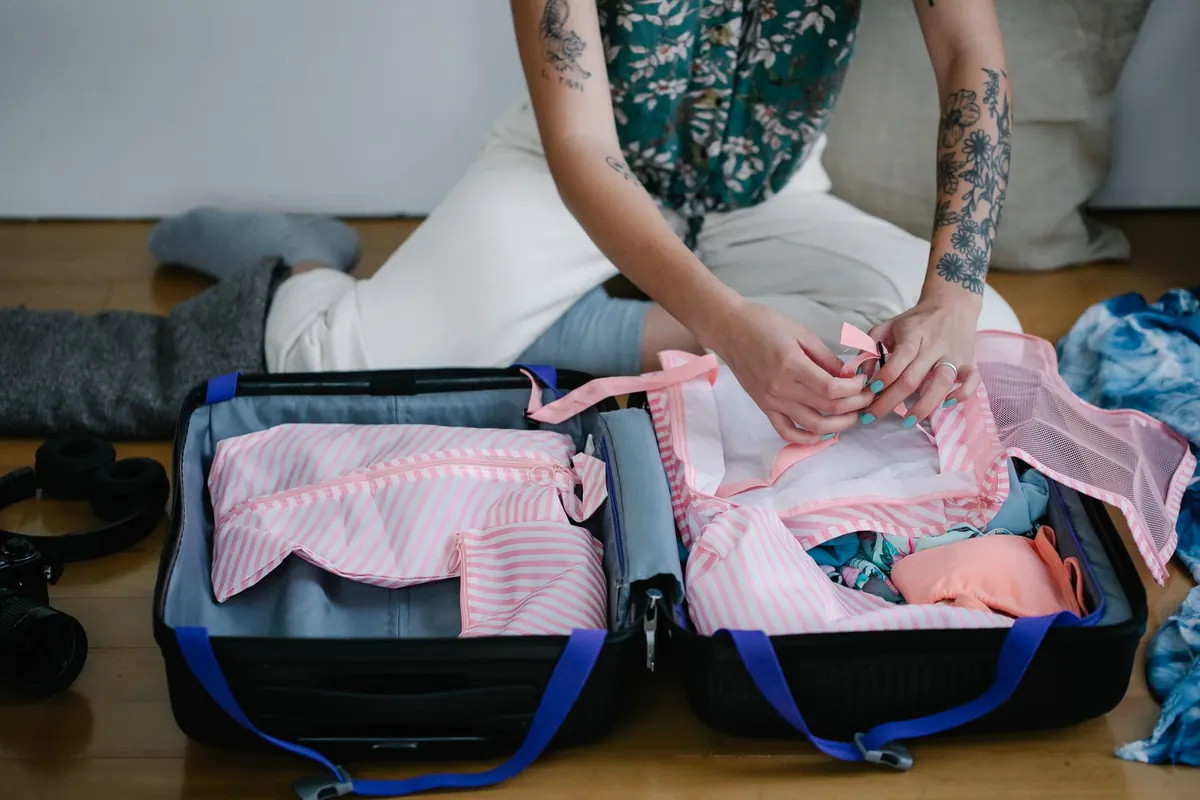
Roll soft clothing and use two packing cubes: one for tops, one for everything else. Put the laptop in a sleeve against your back, cables in the top pocket, and heavy items low and close to your spine. Wear your bulkiest layers on the plane.
Then split your luggage into two loads. The cabin bag goes overhead; a small personal item goes under the seat with your passport, phone, charger, power bank, medication and one change of clothes. If the cabin bag gets gate-checked, you have lost nothing important. Leave about a tenth of the space free — you will buy something, and a bag that closes easily on day one is a bag that fights you in month three.
The night-before check
Lay everything out, pack it, weigh it, then remove one third of the “just in case” items. Photograph the open bag for insurance, screenshot your documents and boarding passes, download offline maps for your first city, and charge every device. Confirm your airline's cabin limits one last time — they change with fares and aircraft. Then walk around the block with the bag on. If you can do that comfortably, you can live out of it.
Photo: Timur Weber / Pexels